
SEO is the long-term work of making your website the first thing your customers see when they search. Done right, it compounds for years. Done wrong, it eats budget without moving rankings.
Signs your business needs SEO work
- Your competitors rank ahead of you for the keywords your customers search, even though their websites look worse
- Organic search traffic has flatlined for 6+ months despite publishing content
- You don't appear in the Google Map Pack for "seo services Kamphaeng Phet" searches
- Your pages take 4+ seconds to load on mobile — Google penalises this aggressively
- No Thai-language version of your site, even though half your market searches in Thai
- You rely entirely on Google Ads — turn off ads, traffic drops to zero
- No idea what keywords your customers actually search for
How weak SEO impacts your business
Every Google search you don't show up in is a customer who buys from someone else.
Lost revenue
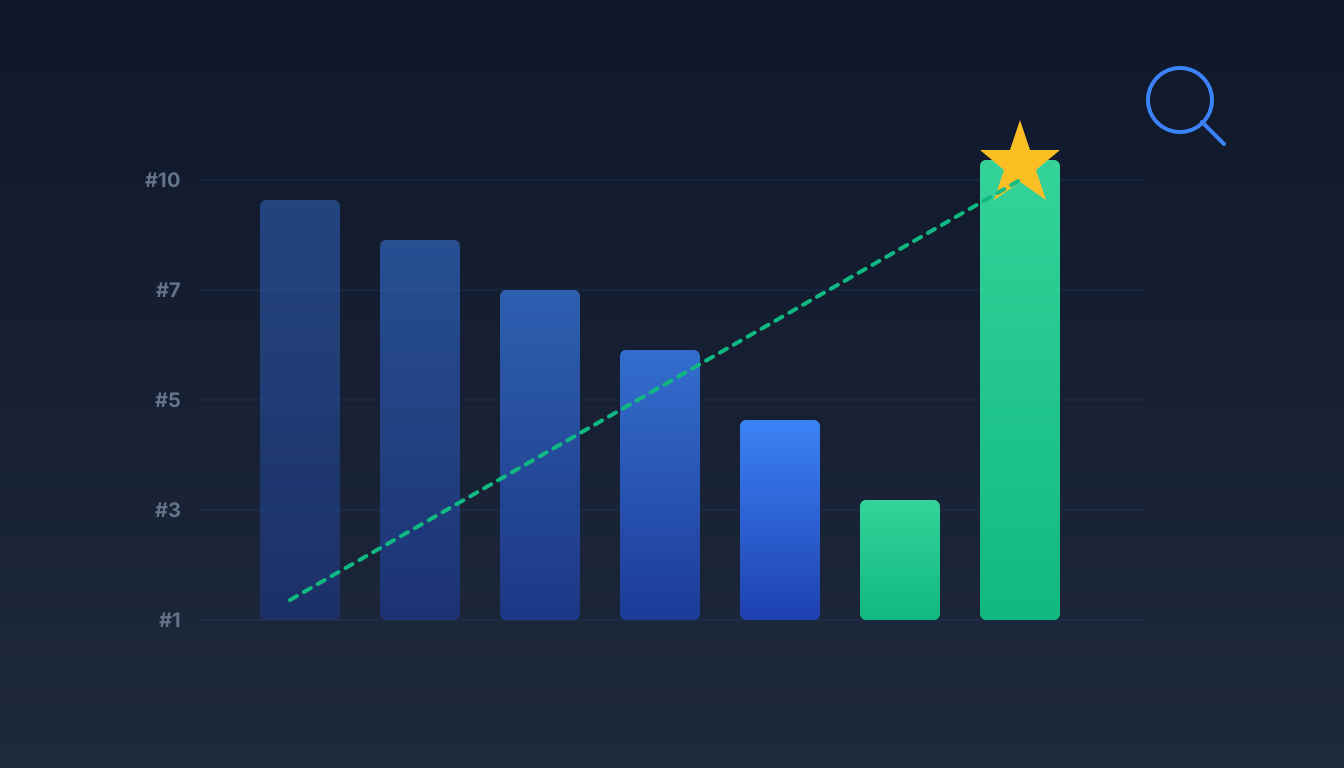
the average #1 result gets 28% of clicks; #5 gets 5%; #10 gets 2.5%
Higher Google Ads costs
Google charges advertisers more when their organic presence is weak
No compounding value
paid traffic stops the moment you stop paying; SEO traffic builds equity
Vulnerable to competitors
they invest in SEO and overtake you year-on-year
No local discoverability
without Map Pack rankings, walk-in foot traffic dries up
What we deliver
Technical SEO audit
fix crawl errors, speed issues, indexation problems, schema markup
On-page optimisation
content structure, internal linking, title/meta tuning by query
Content strategy
what to publish, in what order, in which language (Thai/English) — see content writing and programmatic mass pages
Tier 1 backlinks
high-authority links from real Thai publishers and global press, paired with our backlinks service
Local SEO
Google Business Profile, citations, map-pack targeting per city
Monthly reporting
rankings, organic traffic, conversions tracked against named KPIs
Realistic SEO timeline: meaningful ranking movement in 60-90 days; competitive keywords in 6-12 months. See the SEO FAQ or read why we win retainers. Anyone promising faster is selling you fake guarantees.
Related services
This service is one piece of our full digital marketing services lineup. It works best alongside:
- high-authority backlink building — feeds the off-page authority signal
- internal link architecture — compounds the on-page weight
- Thai-native content writing — produces the pages that rank
- Google Business Profile work — captures the local-pack searches
Run a specialised business? We also do focused SEO for e-commerce stores, hotels, law firms, real estate, and small businesses.
Not sure which combination fits? Start with a free SEO audit, and if you are chasing visibility in AI answers like ChatGPT and Google's AI Overviews, look at AI search optimization. Get a free audit and we will recommend the smallest engagement that hits your goal.
Kamphaeng Phet usually gets remembered as the historical park that travellers skip on the way north to Sukhothai — which is unfair, because its laterite city walls, the Aranyik forest temples, and the museum complex form one of the most atmospheric Sukhothai-era sites in the country, listed by UNESCO alongside Sukhothai itself. The difference is footfall. Far fewer visitors stop here, and that has held the local economy to its agricultural core: this is serious banana country, plus rice and sugarcane across the districts toward Khlong Khlung and Sai Ngam. The town serves as the market and services centre for that farming hinterland.
The search picture follows from there. Outside a modest band of heritage-tourism phrases — most of them Thai, with a thin layer of English from culture travellers — the demand is small, local, and almost entirely Thai-language: agricultural suppliers, produce buyers, local trades, the occasional homestay. Competition across all of it is light, and very few of these businesses have anything beyond a social page, so the bar to rank is low.
The shape of the Kamphaeng Phet market
We work with a small number of agricultural businesses and homestay operators in and around Mueang Kamphaeng Phet. The sensible play is a compact Thai-language site built around the handful of product and service terms that actually get searched, clean local markup, and a Google Business Profile that owns the district map pack. It is a low-cost market where a well-built page tends to stay put because almost nobody is pushing against it.
There is also a quiet long-tail worth capturing: travellers who do reach the historical park often look for somewhere to stay, eat, or buy local produce nearby, and a banana farm or homestay that shows up for those searches gets a steady trickle of buyers the bigger names never bother to chase. We treat that overflow from the heritage site as a small but free channel rather than the main event.
How we cover it from Pattaya
Pattaya to Kamphaeng Phet is about five hours, so the model is remote management over LINE and WhatsApp with one or two travel-in visits a year — typically a kickoff and an annual review. There is no local office and we do not pretend otherwise; the value is in the work and the reporting, not a pin on a map.
Our team is in Pattaya, roughly a few hours by road from Kamphaeng Phet. We are honest about being a Pattaya team that serves Kamphaeng Phet — not a fake local office.