
SEO in Phuket: the tourism-driven search market
Phuket's search market doesn't look like Bangkok's. Roughly 70% of competitive queries here are tourism-intent — hotel bookings, dive shops, villa rentals, restaurants, day-trip activities — and the remaining 30% covers local-resident services like medical, schools, real estate, and trade businesses. That ratio shapes everything: keyword research, content cadence, link strategy, even how we measure success.
Seasonality is the single biggest factor most agencies underweight. November through March is high season, when search volume across hospitality categories runs 2.5–3.5x the May–October monsoon lows. A site that ranks beautifully in February can collapse in revenue terms in July if its keyword mix isn't deliberately spread across year-round demand. We plan editorial calendars around this: publish in the off-season for high-season ranking, because Google needs 60–120 days to fully credit new content.
The other defining factor is language. Phuket is the most multilingual SERP in Thailand. A single hotel category will compete across English, Thai, Russian, German, French, and increasingly simplified Chinese. Each language has its own SERP, its own ranking signals, and its own backlink ecosystem. Most foreign-led Phuket agencies handle English only and leave the other four wide open.
The third structural factor is OTA dominance. Booking.com, Agoda, Hostelworld, Expedia, and Tripadvisor occupy the top 5–8 spots on almost every commercial hospitality query. They take 15–25% commission per booking. Phuket businesses cannot ignore them, but they can — and must — build direct-booking SEO that targets the searches OTAs underserve: branded queries, hyper-niche category queries, and post-arrival local queries.
What's different about ranking in Phuket vs Bangkok
The practical differences are larger than they look.
The Phuket SERP is the most multilingual in Thailand. A serious hospitality keyword strategy here covers five languages — English, Thai, Russian, German, and French — with simplified Chinese rising. In Bangkok, English and Thai cover 95% of commercial intent. In Phuket, English-only strategy leaves roughly half the addressable market on the table.
Seasonality is brutal in a way Bangkok never feels. Hospitality search volume drops 60–70% from February peak to August trough. Content that lives on seasonal traffic alone will look like a failing campaign for half the year. We deliberately mix evergreen Phuket-living and Phuket-business content into hospitality client portfolios to smooth this.
OTA aggregators dominate the top of SERP for hotel queries in a way they don't for Bangkok B2B or B2C verticals. The competitive answer is long-tail and branded-query SEO, not head-term competition.
The local pack is more decisive in Phuket because the customer is on the island and searching mobile, in the moment. A clinic in Sukhumvit can rank organically and still win patients; a beach restaurant in Patong without a strong Google Business Profile is invisible.
How we approach Phuket clients specifically
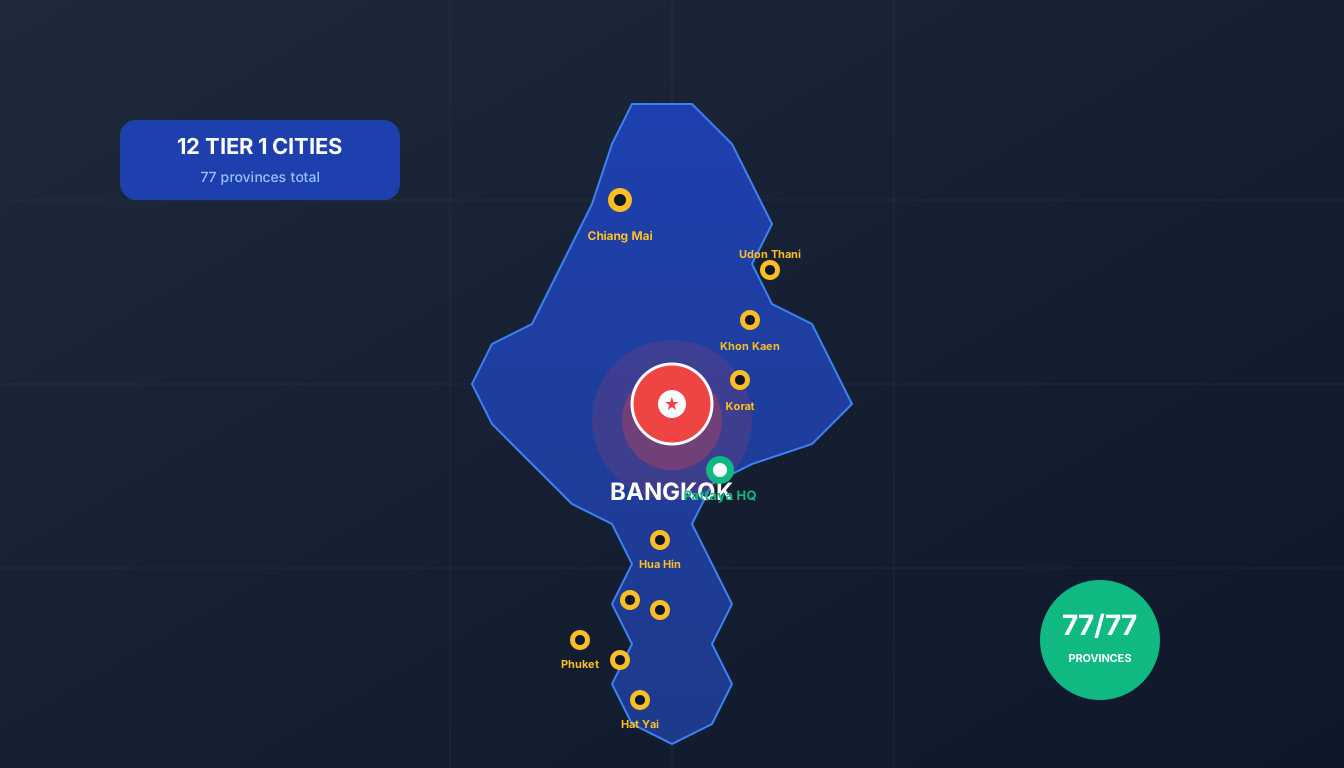
Our HQ is in Pattaya. Phuket is a one-hour-and-twenty-minute direct flight from Bangkok, and we keep a working cadence that mixes on-island and remote work deliberately.
We budget for quarterly in-person visits during high season, weighted toward client-onboarding, content shoots, and partner meetings. Monthly calls handle reporting and tactical adjustments. For larger retainers we'll add a December–February residency week when sales matter most.
Multilingual content is built natively, not translated. We coordinate a Thai writer and an English writer in-house, and bring in freelance Russian, German, French, and simplified-Chinese writers when client ROI justifies the additional language. We don't run machine translation past a Google snippet check — the quality penalty is too high.
The editorial calendar is season-aware. We publish in May–October for November–March ranking, knowing Google's ranking lag is 60–120 days. Clients who only sign in October often miss the peak season they signed up to capture; we are blunt about this in scoping calls.
We run a dual-channel OTA-plus-direct strategy. Fighting Booking.com on "hotels in Phuket" is unwinnable; using OTAs as an awareness layer while building direct-booking SEO for branded and post-arrival queries is the practical strategy. We coordinate property-management-system and channel-manager configurations with the SEO program where clients allow.
Our team is based in Pattaya. Phuket engagements run as a mix of remote work and on-site visits — we are honest about the model rather than claiming a fake local office.