
SEO is the long-term work of making your website the first thing your customers see when they search. Done right, it compounds for years. Done wrong, it eats budget without moving rankings.
Signs your business needs SEO work
- Your competitors rank ahead of you for the keywords your customers search, even though their websites look worse
- Organic search traffic has flatlined for 6+ months despite publishing content
- You don't appear in the Google Map Pack for "SEO services Chiang Rai" searches
- Your pages take 4+ seconds to load on mobile — Google penalises this aggressively
- No Thai-language version of your site, even though half your market searches in Thai
- You rely entirely on Google Ads — turn off ads, traffic drops to zero
- No idea what keywords your customers actually search for
How weak SEO impacts your business
Every Google search you don't show up in is a customer who buys from someone else.
Lost revenue
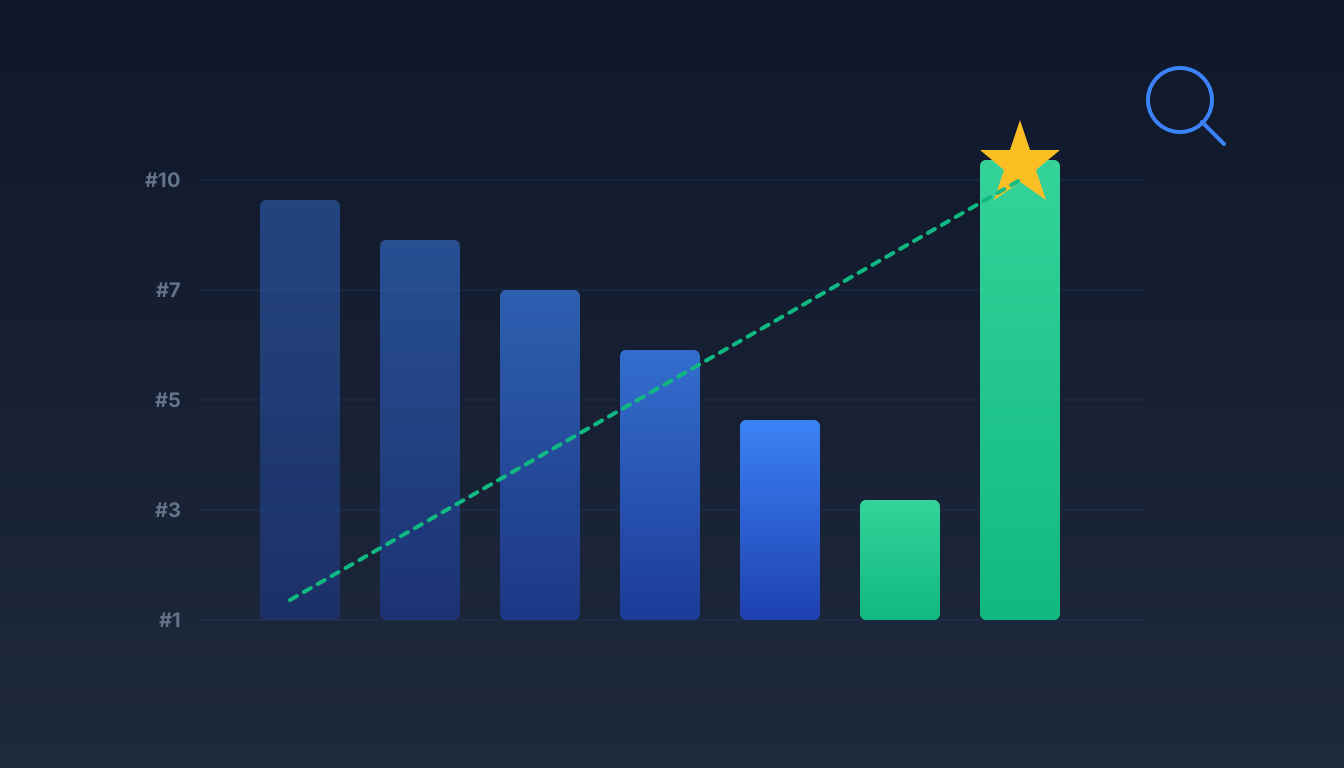
the average #1 result gets 28% of clicks; #5 gets 5%; #10 gets 2.5%
Higher Google Ads costs
Google charges advertisers more when their organic presence is weak
No compounding value
paid traffic stops the moment you stop paying; SEO traffic builds equity
Vulnerable to competitors
they invest in SEO and overtake you year-on-year
No local discoverability
without Map Pack rankings, walk-in foot traffic dries up
What we deliver
Technical SEO audit
fix crawl errors, speed issues, indexation problems, schema markup
On-page optimisation
content structure, internal linking, title/meta tuning by query
Content strategy
what to publish, in what order, in which language (Thai/English) — see content writing and programmatic mass pages
Tier 1 backlinks
high-authority links from real Thai publishers and global press, paired with our backlinks service
Local SEO
Google Business Profile, citations, map-pack targeting per city
Monthly reporting
rankings, organic traffic, conversions tracked against named KPIs
Realistic SEO timeline: meaningful ranking movement in 60-90 days; competitive keywords in 6-12 months. See the SEO FAQ or read why we win retainers. Anyone promising faster is selling you fake guarantees.
Related services
This service is one piece of our full digital marketing services lineup. It works best alongside:
- high-authority backlink building — feeds the off-page authority signal
- internal link architecture — compounds the on-page weight
- Thai-native content writing — produces the pages that rank
- Google Business Profile work — captures the local-pack searches
Run a specialised business? We also do focused SEO for restaurants, e-commerce stores, hotels, clinics & dental, law firms, real estate, and small businesses.
Not sure which combination fits? Start with a free SEO audit, and if you are chasing visibility in AI answers like ChatGPT and Google's AI Overviews, look at AI search optimization. Get a free audit and we will recommend the smallest engagement that hits your goal.
Chiang Rai sits at the top of Thailand, where the country presses up against Myanmar and Laos at the Golden Triangle. For a search-marketing brief this matters because the province carries three distinct visitor audiences at once. The first is the temple-circuit tourist who arrives for Wat Rong Khun (the White Temple), the Blue Temple, and Baan Dam (the Black House) — a one-or-two-day loop that feeds a dense layer of hotel, transfer, tour, and restaurant queries.
The second is the highland produce buyer, because Doi Mae Salong, Doi Chang, and Choui Fong are not decorative names but working tea and coffee estates whose beans and leaves reach roasters and wholesalers well beyond the province. The third is cross-border, anchored on Mae Sai and Chiang Saen, where trade with Myanmar shapes a quieter but real commercial-services demand.
Search language splits in a way few Thai provinces do. Thai dominates everyday local services, but the temple loop and the Golden Triangle pull a substantial English audience, and Chinese-language search is meaningful here in a way it simply is not in, say, Phrae or Phayao — Chiang Rai has long been a stop on overland and packaged routes out of Yunnan. A coffee or tea estate that wants to sell direct, or a guesthouse near the White Temple, is realistically optimising for two or three languages, not one.
Competition and the export angle
Against Chiang Mai, the field is lighter almost everywhere — fewer agencies chase Chiang Rai keywords, and the temple and highland-produce categories in particular are winnable inside a year of disciplined work. The export angle is the one worth naming plainly: a roaster on Doi Chang searching for "single origin Thai coffee" or a tea house on Doi Mae Salong reaching for oolong buyers is competing nationally and sometimes internationally, so the content and link work look different from a city-services campaign. We treat those as their own track, with English and product-led pages doing the heavy lifting and Thai pages handling the domestic café and tourism trade.
We have done modest work here with boutique hotels around the temple circuit, a couple of highland coffee brands, and F&B operators in Mueang Chiang Rai. Chiang Rai is a domestic flight from our Pattaya base, so site visits are occasional rather than routine and most of the relationship runs remotely — which suits a market where the real tap is in patient, well-structured pages rather than constant on-the-ground presence. Run by Kanoktip Lergdee from 49/41 Phatthaya Tai 12 Alley, Pattaya; reach us on +66 87 773 7715.
Our team is in Pattaya, roughly a domestic flight from Chiang Rai. We are honest about being a Pattaya team that serves Chiang Rai — not a fake local office.