
SEO is the long-term work of making your website the first thing your customers see when they search. Done right, it compounds for years. Done wrong, it eats budget without moving rankings.
Signs your business needs SEO work
- Your competitors rank ahead of you for the keywords your customers search, even though their websites look worse
- Organic search traffic has flatlined for 6+ months despite publishing content
- You don't appear in the Google Map Pack for "seo services Bueng Kan" searches
- Your pages take 4+ seconds to load on mobile — Google penalises this aggressively
- No Thai-language version of your site, even though half your market searches in Thai
- You rely entirely on Google Ads — turn off ads, traffic drops to zero
- No idea what keywords your customers actually search for
How weak SEO impacts your business
Every Google search you don't show up in is a customer who buys from someone else.
Lost revenue
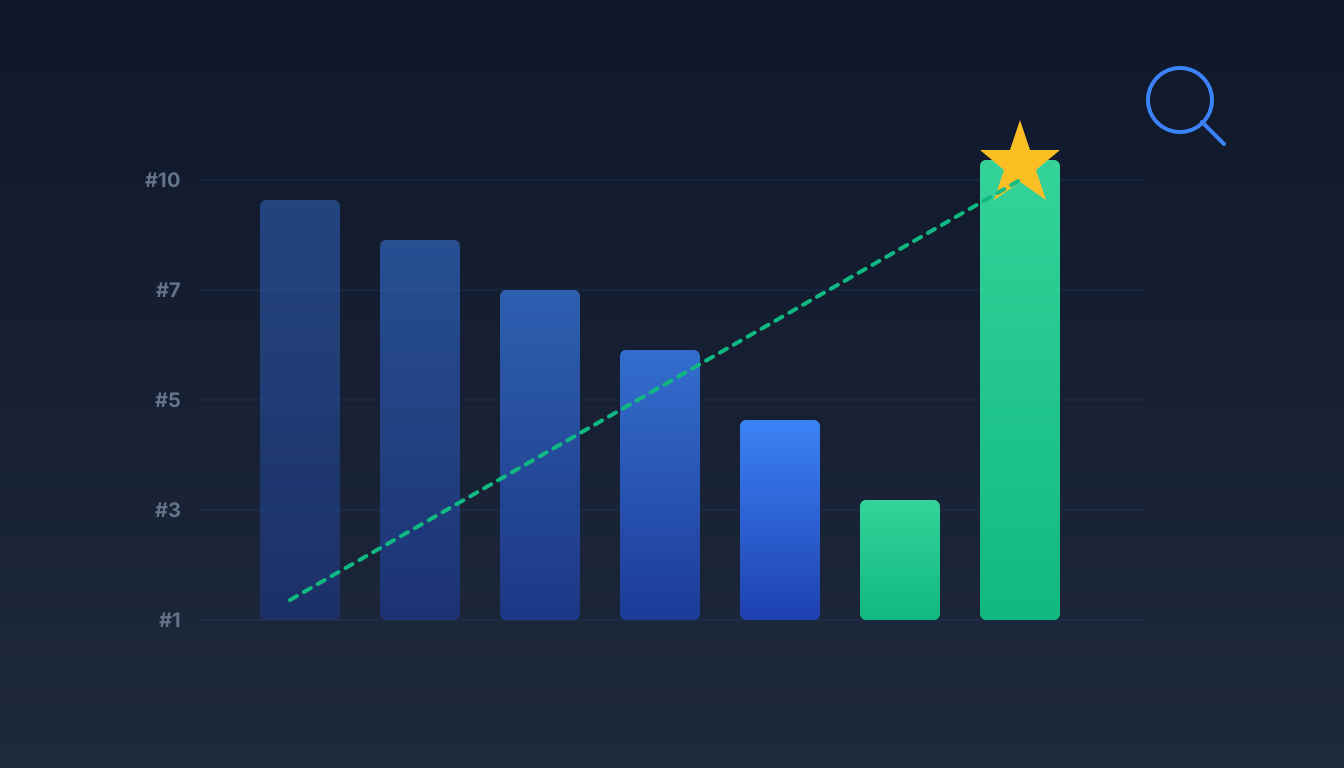
the average #1 result gets 28% of clicks; #5 gets 5%; #10 gets 2.5%
Higher Google Ads costs
Google charges advertisers more when their organic presence is weak
No compounding value
paid traffic stops the moment you stop paying; SEO traffic builds equity
Vulnerable to competitors
they invest in SEO and overtake you year-on-year
No local discoverability
without Map Pack rankings, walk-in foot traffic dries up
What we deliver
Technical SEO audit
fix crawl errors, speed issues, indexation problems, schema markup
On-page optimisation
content structure, internal linking, title/meta tuning by query
Content strategy
what to publish, in what order, in which language (Thai/English) — see content writing and programmatic mass pages
Tier 1 backlinks
high-authority links from real Thai publishers and global press, paired with our backlinks service
Local SEO
Google Business Profile, citations, map-pack targeting per city
Monthly reporting
rankings, organic traffic, conversions tracked against named KPIs
Realistic SEO timeline: meaningful ranking movement in 60-90 days; competitive keywords in 6-12 months. See the SEO FAQ or read why we win retainers. Anyone promising faster is selling you fake guarantees.
Related services
This service is one piece of our full digital marketing services lineup. It works best alongside:
- high-authority backlink building — feeds the off-page authority signal
- internal link architecture — compounds the on-page weight
- Thai-native content writing — produces the pages that rank
- Google Business Profile work — captures the local-pack searches
Run a specialised business? We also do focused SEO for e-commerce stores, hotels, law firms, real estate, and small businesses.
Not sure which combination fits? Start with a free SEO audit, and if you are chasing visibility in AI answers like ChatGPT and Google's AI Overviews, look at AI search optimization. Get a free audit and we will recommend the smallest engagement that hits your goal.
Bueng Kan is the newest province in Thailand, split from Nong Khai in 2011, and it has two very different economic stories running at once. The older one is rubber: Bueng Kan produces the largest volume of natural rubber in Isan, with smallholder plantations spread across Seka, Pak Khat, and most other districts, plus the processing and trading businesses that sit on top of that supply.
The newer one is tourism, driven hard by Wat Phu Tok — the dramatic cliff-side monastery reached by wooden walkways — and especially by the Tham Naka (Naga Cave), whose serpent-shaped rock formations went viral domestically and turned a remote forest park into a genuine bucket-list destination for Thai travellers.
Those two stories create two distinct search audiences. On the rubber side, queries are B2B and Thai-language: latex pricing, processing, suppliers, equipment. On the tourism side, demand has been rising fast and is heavily seasonal and Thai-language too — accommodation, how to reach the Naga Cave, permits, nearby food and homestays. A guesthouse or tour operator that ranks for Naga Cave and Phu Tok queries is tapping a wave that is still building, which is an unusually good position in a small province.
Effectively zero competition
Across most commercial categories here, competition is genuinely absent — Bueng Kan is new enough and remote enough that almost no agency has bothered to target it. For both the rubber-industry clients and the rising tourism businesses, that means ติดอันดับ on core terms is realistically achievable inside three to six months and cheap to hold afterward. We build separate content tracks for the rubber B2B audience and the Naga-Cave tourism audience rather than blurring them together.
Working from Pattaya
Bueng Kan is one of the more remote provinces we cover — a flight into Udon Thani or Nakhon Phanom followed by a drive of around two hours. We manage the ongoing work remotely over LINE and WhatsApp with regular reporting and calls, and travel up for a kickoff and on-site shoot at Phu Tok or the riverfront when a tourism project warrants it. To discuss รับทำ SEO in Bueng Kan, contact Kanoktip Lergdee at our Pattaya office, 49/41 Phatthaya Tai 12 Alley, +66 87 773 7715.
Our team is in Pattaya, roughly a few hours by road from Bueng Kan. We are honest about being a Pattaya team that serves Bueng Kan — not a fake local office.